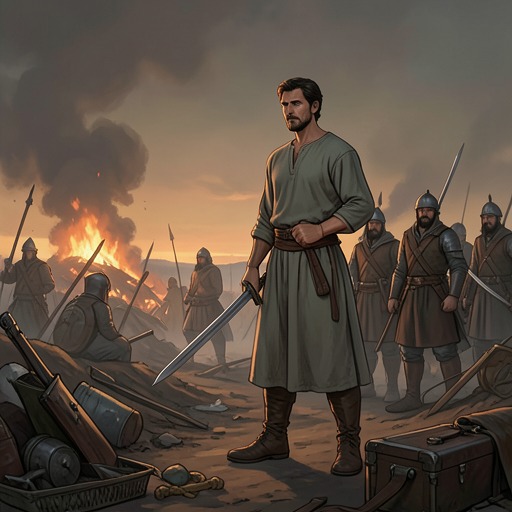
Jiangyou
The Romance of the Three KingdomsJiangyou is the first city Deng Ai’s force captures after its hazardous crossing of Heaven-Scraping mountain, turning an improbable mountain passage into a breach in Shu’s defenses. Its fall is the immediate result of surprise: the Wei troops arrive by a route their opponents do not expect, and the news alarms the Shu court.
Setting and Strategic Context
Jiangyou appears in the account of the final Wei invasion of Shu as a key point on Deng Ai’s advance toward Chengdu. The route to it is made possible by a prolonged, difficult crossing of Heaven-Scraping mountain. For twenty days, Deng Ai’s men climb and make a path so that supplies can follow; after reaching the summit, they descend the steep face on the far side, with some men using felt jackets to roll down and others relying on ropes and trees.
Capture and Its Immediate Effect
The mountain crossing gives Deng Ai’s army the element of surprise, and the troops take Jiangyou with ease. The city’s capture is therefore not presented as the result of a prolonged siege or a contest described in detail, but as the first consequence of an unexpected approach through formidable terrain. That change in the direction of the campaign carries the threat closer to the Shu capital.
Alarm in Shu and Narrative Significance
News of the advance reaches the Shu ruler, who is profoundly alarmed, but Huang Hao dismisses the reports as false. Although the ruler asks to consult the shaman again, she cannot be found. The delay contrasts with the speed of Deng Ai’s movement: after the fall of Jiangyou, the danger is already pressing forward while the court struggles to respond. Officials eventually propose summoning Zhuge Zhan to command the troops at Chengdu, marking the transition from disbelief to a belated effort at defense.
Jiangyou’s narrative importance lies in its position between the mountain crossing and the subsequent defense of Shu. Its capture demonstrates how terrain can serve both as an obstacle and as a concealed route of attack; the extraordinary passage makes the city vulnerable and transforms an arduous march into a sudden strategic opening.